Why Generic ERP Fails Fuel Businesses (and What to Look for Instead)
Fuel sits in tanks, sells in shifts and changes price constantly. Here are six places a generic ERP falls short for fuel businesses, and a checklist for choosing one that doesn't.
 Simplemind business
6 min read
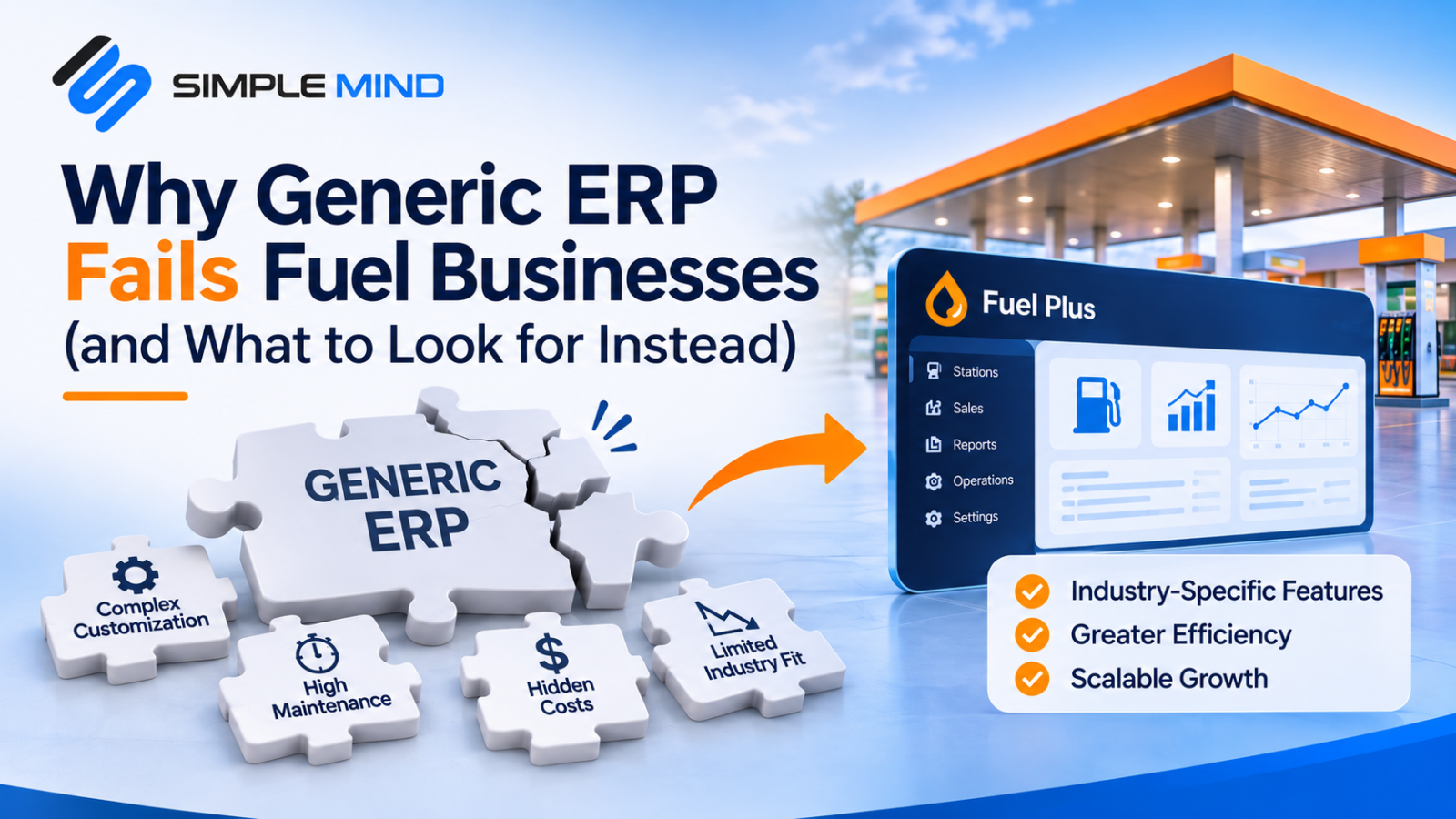
It’s the second week of the month. Your finance team is still closing last month. Someone is copying supplier delivery figures from a PDF into the system by hand. Someone else is chasing three station managers for shift reports that should have arrived on the 1st. And the CFO is asking a simple question nobody can answer quickly: which sites actually made money?
If that sounds familiar, the problem probably isn’t your people. It’s that your ERP was designed for a business that sells boxes, not litres.
We’ve spent years building and supporting SAP Business One systems for fuel companies. Distributors, station networks, and one network we work with that runs more than 50 stations. The pattern repeats so often that we can almost predict where the pain will be before the first meeting. A good ERP for fuel distributors has to handle a handful of things that general-purpose systems simply weren’t built for.
In a recent meeting, a fuel client walked us through what was wrong with their current system. The list came quickly. It was old-fashioned. Routine work took hours. Nothing could be exported to a spreadsheet, so every report started with someone copying numbers off a screen. And it was generic: it handled the accounting, but it had no idea how a fuel business actually runs, from shifts to tanks to supplier deliveries.
None of those complaints surprised us. We’d heard each of them before from other fuel companies. That’s the part that’s easy to miss: when a system can’t do the job, people quietly build the job around it, and the workarounds become the process.
Here are the six gaps we see most, what each one costs, and what to look for instead.
Gap 1: Inventory that thinks in units, not in tanks
A standard ERP tracks stock as items moving in and out of a warehouse. Fuel doesn’t behave like that. It sits in underground tanks, it’s measured by dips and totaliser readings, and the number in the system and the number in the tank are rarely identical. Some variance is normal. A lot of variance is a problem: a leak, a calibration fault, or theft.
What it costs you: When the ERP can’t compare book stock against physical readings per tank, variances get spotted weeks late, if at all. By then you’re investigating a month of data instead of one shift.
Look for: Tank-level stock, reconciliation of book versus measured volumes, and variance alerts you can set thresholds on.
Gap 2: Supplier data that arrives in a dozen different shapes
Every fuel supplier and fuel controller system sends data its own way. One sends Excel. Another sends CSV with different column names. A third exports a DAT file that only one person in the office knows how to read. Generic ERPs expect clean, consistent input, so someone ends up re-keying it.
What it costs you: Hours of manual entry every week, plus the errors that come with it. A wrong product code or a transposed digit on a delivery quantity flows straight into your costing and your margins.
Look for: Automated import that can parse multiple supplier formats, validate the data, and post it into the ERP as proper documents without someone typing it in.
Gap 3: The day is the wrong unit of time
Most ERPs think in documents and days. Fuel stations think in shifts. Money changes hands, attendants hand over, and the responsibility for a cash drawer moves from one person to the next, sometimes three times in 24 hours.
What it costs you: If your system can’t close and reconcile by shift, you can’t pin a shortfall to the person or the period it happened in. Disputes become arguments instead of facts.
Look for: Shift-based reporting with opening and closing readings, payments by type, and variances per shift and per attendant.
Gap 4: Prices that move faster than your master data
Fuel prices change often, sometimes daily, and in some markets mid-shift. If you run several sites, you may also have different prices by location or by customer agreement. In a generic ERP, updating prices across sites is manual and slow, and historic prices get overwritten or lost.
What it costs you: Sales booked at the wrong price, margins that don’t add up, and no clean history when an auditor or a customer asks what price applied on a particular day.
Look for: Central price management with effective dates, per-site and per-customer pricing, and a full price history.
Gap 5: One sale, four ways to pay
A single forecourt takes cash, bank cards, fleet cards, and credit on account for business customers. Each one settles differently and on a different timeline. Card money lands days later. Fleet credit needs invoicing. Cash needs counting and banking.
What it costs you: When the ERP lumps these together, matching sales to money received becomes a monthly detective exercise. Unbilled fleet credit is lost revenue, plain and simple.
Look for: Payment-type breakdown per shift, card settlement matching, and fleet or account customers invoiced automatically from the transaction data.
Gap 6: Head office can’t see the forecourt
The last gap is visibility. A generic ERP will give you a trial balance. It won’t tell you, on Tuesday morning, which three sites had unusual variances over the weekend, or which station’s margins are slipping.
What it costs you: Decisions made on month-old data. Problems that a dashboard would have flagged in a day sit unnoticed for weeks.
Look for: Dashboards built around fuel KPIs: volume by site, margin by product, variances, outstanding credit, and shift exceptions.
What this adds up to
None of these gaps is dramatic on its own. That’s what makes them dangerous. Each one is a small, daily leak that your team patches with spreadsheets and goodwill. Put all six together and you have a finance team working overtime to produce numbers that still arrive late.
We should be honest about one thing. Not every fuel business needs a specialised system on day one. If you run one or two sites with simple pricing and a single supplier, a well-configured standard ERP plus disciplined processes can carry you for a while. The gaps start to hurt when you add sites, suppliers, and customers on credit. That’s usually when people call us.
Checklist: what a fuel-ready ERP should include
Use this when you evaluate any system, ours included:
- Tank-level inventory with book versus measured reconciliation
- Automated import of supplier and fuel controller files (Excel, CSV, DAT and others)
- Validation of imported data before it posts
- Shift-based closing and reporting
- Central price management with effective dates and history
- Per-site and per-customer pricing
- Payment-type breakdown, including fleet and account credit
- Automatic invoicing for credit customers
- Multi-site dashboards built on fuel KPIs
- Proper financial integration, so none of the above lives in a side spreadsheet
- A partner who understands both the ERP and the forecourt
Where we fit
We built FUEL PLUS on top of SAP Business One because we kept seeing the same six gaps. It’s available as an SAP B1 desktop add-on and as a web client, and it covers supplier imports, shift reports, pricing, dashboards and the rest of the list above. If you already run SAP Business One, or you’re considering it, you can read more on our SAP Business One page and the FUEL PLUS product section.
If you’d rather talk it through, book a free scoping call. We’ll look at how you work today, tell you honestly which gaps matter for your operation, and whether you need us at all.